‘So Macbeth is like Icarus?’: An English Literature tutor’s guide to the theme of hubris in ‘the Scottish play’.
In one of my recent tutoring sessions, I was talking about the character of Macbeth and his hubris, and how his character was an example of consequence for defying God. In this conversation with my tutee, who is a big fan of Greek mythology, he asked me - “So Macbeth is like Icarus?”. I thought this was a fantastic question, and this later became the fulcrum (key idea) of my tutoring session.
Key terms:
It is important to define some of these key terms before we dive deeper into this topic, however. Here are the key terms I’m going to be using throughout this blog post:
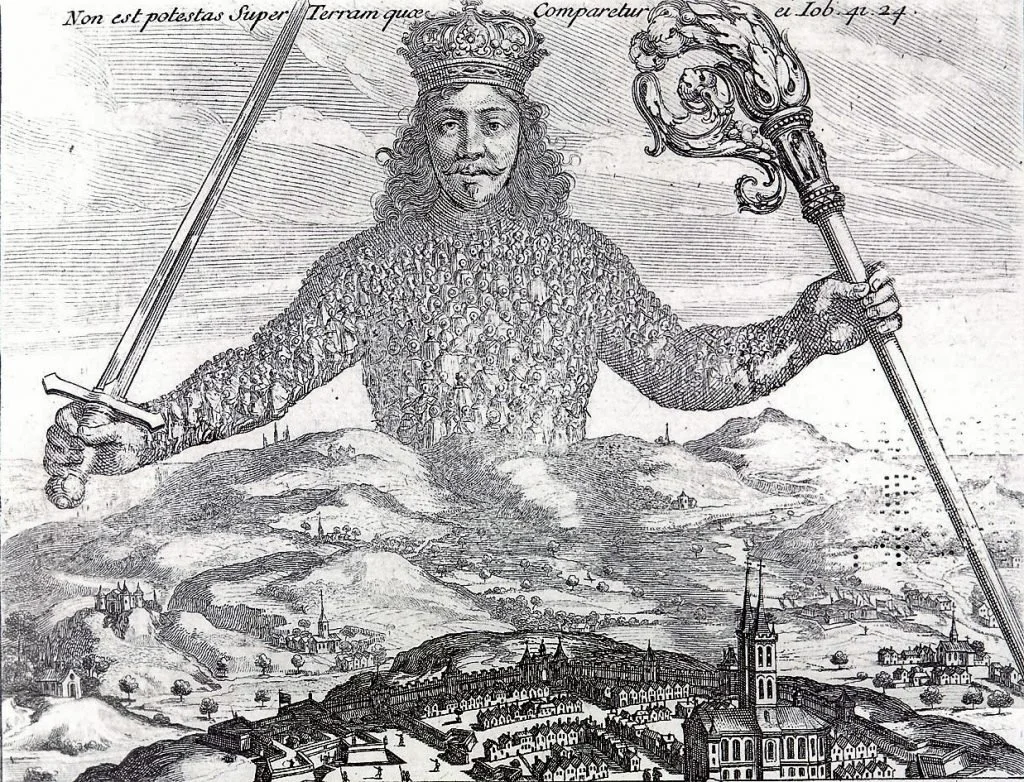
An image from Thomas Hobbes’ ‘Leviathan’ representing the Divine Right of Kings.
Hubris - excessive pride or defiance, especially towards the gods, leading to retribution or consequences.
The Gunpowder Plot of 1605 - a plot lead by Robert Catesby and various other English Catholics to kill King James and install his 9-year-old daughter, Princess Elizabeth, as monarch.
The Divine Right of Kings - heavily upheld by Henry VIII and maintained by his successors to the throne afterwards (including Queen Elizabeth I and King James I & VI), the Divine Right of Kings is a belief that the monarch is chosen by God by virtue of their birth, and therefore any act of treason against the monarch is “sacrilegious”, which means violation of what is holy and good (this is maintained by Macduff’s response after discovering King Duncan’s body).
Consequence - not necessarily good or bad, but simply a reaction to a choice or action that is taken. If you are a chef and wash your hands before cooking (action), your hands are clean and therefore your food is more hygienic (consequence). However, if you do not wash your hands (action), you stand the chance of spreading infection or dirt from your hands into the food, resulting in the people who eat it perhaps becoming sick (consequence).
Nemesis - an inescapable agent of one’s own, or another’s, downfall.
The story of Icarus
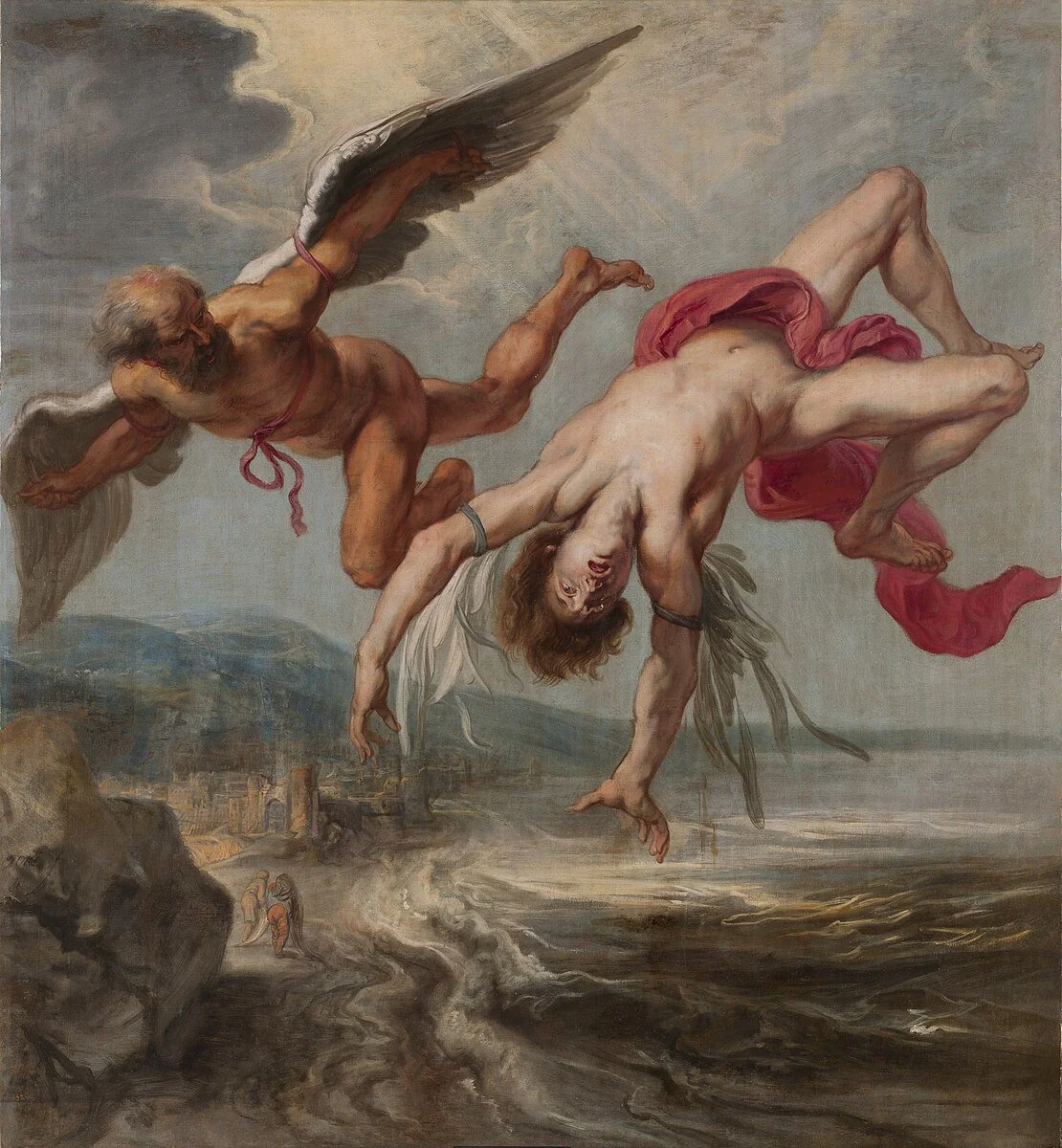
Icarus falling after flying too close to the sun, watched by his father Daedalus.
For those unfamiliar with the story of Icarus, it is a Greek myth about youthful arrogance leading to hubris, and later, consequence - Icarus’s father, Daedalus, crafts wings out of wax and feathers which allow Icarus to fly. Whilst he is flying, he ignores his fathers warnings about flying too close to the sun (hence the idiom) and the wax holding his wings together begins to melt. Icarus falls into the sea below, presumably to his death. The Ancient Greeks will have interpreted this story as a warning about defying both mortal authority (his father) and the Gods’ authority (the sun). Icarus’s arrogance in flying too close to the sun (action) resulted in his wings melting and eventually his death (consequence). Whilst there is some nuance in how closely the arc of Icarus and the arc of Macbeth actually align, I think there is a very valuable interpretation to be made from this comparison.
In both stories, the protagonists defy the will of the Gods and experience consequences for doing so. Icarus when he flies into the realm of the Gods and the wax melts. Macbeth when he kills King Duncan, whom the Jacobeans will have recognised as the representative of God on Earth, and the resulting chaos in the natural world, and his and Lady Macbeth’s rapid descent into madness.
Macbeth as a mirror to society
Macbeth mirrors the story of Icarus quite neatly; both characters have aspirations towards a higher position in society (Macbeth in desiring to become king, Icarus in physical height) and both characters succeed - if only for a time.

Macbeth, pictured here after killing King Duncan.
When Macbeth hears that King Duncan is choosing Malcolm as his successor, Shakespeare uses an aside to the audience saying “Stars hide your fires; let not light see my black and deep desires”. Macbeth has already been caught by Banquo “rapt withal” the promises of the witches, and makes it clear to the audience that he does aspire towards kingship very early in the play. The imagery of fire and light here is no mistake either; the “fire” of the stars is a clear allusion to the sun in the story of Icarus by Shakespeare.
One might also be able to argue that the “fires” refer to the goal of the Gunpowder Plot - to blow up the Houses of Parliament whilst King James was within. We can see this image repeated annually in the bonfires we build every 5th November. Here, Shakespeare clearly establishes Macbeth as a nemesis to King Duncan - once “brave” and noble, Macbeth is now the cause of Duncan’s demise. He also establishes Macbeth’s ambition as his own nemesis - Macbeth and Lady Macbeth both reject the “light” and instead turn to their “black and deep desires”; turning away from God, and towards hell.
Macbeth’s ambition is set up as a mirror to the ambitions of Catesby and the others involved in the Gunpowder Plot; and in the same way that Catesby and his fellow conspirators were caught, arrested, or killed, Shakespeare is warning others in society that going against the king will only lead to the collapse of the natural order, chaos, war, and anarchy. These are themes that would be later picked up by Thomas Hobbes in his book ‘Leviathan’, first published in 1651, which argues that an absolute sovereign is required to maintain order in society.
Indeed, after committing regicide, Macbeth’s strength as portrayed at the start of the play where he “unseams” the rebel Macdonwald “from the nave to the chaps” with his “brandished steel” is eaten away at by his own guilt, and the ensuing chaos of the natural world. Shakespeare has Lennox speak to Macbeth the morning after Duncan’s “sacrilegious murder” and explain how in his recent memory (“my young remembrance”) he cannot think of any night as chaotic as the night before. The owl (“obscure bird”) was hooting and screeching (“clamoured”) all night, and even the earth itself was beset by sickness - “the earth was feverous and did shake”. For daring to go against the Divine Right of Kings, and kill God’s representative on Earth, even the land of Scotland is rebelling against Macbeth. Shakespeare is clearly positioning himself as an ally of King James through this, and warning others that they must not go against the King - or else God himself might be angry with you, too. This isn’t the first time Shakespeare uses the chaos of the natural world to mirror ill kingship either, indeed he uses this same imagery in Richard III in Act 2, Scene 3 when a citizen comments on how the ocean’s “waters swell before a boist'rous storm” to show Richard’s selfishness and cruelty, and warn about the coming political instability in England.

Macbeth and Banquo meeting the Witches and receiving their first set of prophesies.
Clearly, this shows that Shakespeare is not a neutral political figure. It is known that King James was his patron, paying Shakespeare’s company to create and perform these plays. It was in Shakespeare’s best interest to appeal to the King and his rampant paranoia about the stability of his reign. This is further supported when Shakespeare writes that Banquo, whom King James believed himself a distant descendant of, would “get kings, though [Banquo] shall be none”, and in Act 4 Scene 1 Shakespeare further emphasises his belief in the legitimacy of King James’s rule through the stage directions “A show of eight kings, the eighth king with a glass in his hand, and Banquo last”. The “glass” being a hand-mirror; one can imagine that in the first showing attended by King James, the actor playing the eighth king might have turned his mirror towards James and reflected back James’s own face to the audience, legitimising James’s rule as fated and decided by God. In a politically and religiously unstable climate, this one showing of James’s face in the mirror might have been a very bold and clear endorsement by Shakespeare and his company to the king.
Applying this to your essays
Now this is all well and good, but how can you apply these ideas to your essays? Well perhaps you could try the task I have provided below for free! There is an AQA style essay question on consequences in Macbeth, including an extract, some quotes from the wider play, and some contextual information prompts. If you write an answer to this question, I am sure that your English teacher will happily mark your work and provide you feedback.
Download the AQA-style essay question here.
Alternatively, if you’re interested in exploring these ideas with me, my books are open and you can book a 20-minute consultation with me to discuss how we can work together to support your progress in English Language and Literature. I hope this helped your revision!
